
What Fayette County Deeds Convey
The Judge of Probate recording office maintains Fayette County deed records. Each recorded deed shows the parties, a filing date, a book and page or instrument reference, and a legal description. What the deed actually conveys depends on its full text. A short index code cannot answer that.
| Deed Type | What It Does | Common Use |
|---|---|---|
| Warranty deed | Transfers the stated interest with written covenants | Ordinary conveyance |
| Corrected deed | Corrects an error in a prior recorded deed | Name or description repair |
| Quitclaim deed | Transfers only the interest the grantor may hold | Family or title cleanup |
| Estate instrument | May document authority or descent | Will, affidavit, order, or intestate transfer |
| Plat or easement | Defines lots or a limited right | Subdivision and access questions |
The same portal indexes mortgages, assignments, releases, restrictive covenants, powers of attorney, lis pendens, and several lien types. Searching only the DEED type can hide the instrument that explains a burden or clears one.
Fayette Deed Index Search Modes
The Fayette Deeds index supports three modes. One name can run across both parties, against a specified role, or paired with another name and common instrument types. The grantor and grantee fields divide company or last name, first name, and middle initial. A combined field searches either role at once.
| Field group | Choices shown | Best use |
|---|---|---|
| Party | Grantor, grantee, or combined | Test initials, trusts, estates, spouses, and companies. |
| Property | Street, subdivision, lot, block, description | Match a known legal clue. |
| Instrument | Number, book, page, group, and type | Open or narrow a filing. |
| Time and value | Recorded date and consideration ranges | Reduce common-name results. |
Broad searches stop at 1,000 records. The earliest online year and full image pricing are not posted, so old-book and copy questions may still need the office.
See Fayette's Deed Search
The official Fayette land-record screen gathers party, property, date, and instrument filters into one index.
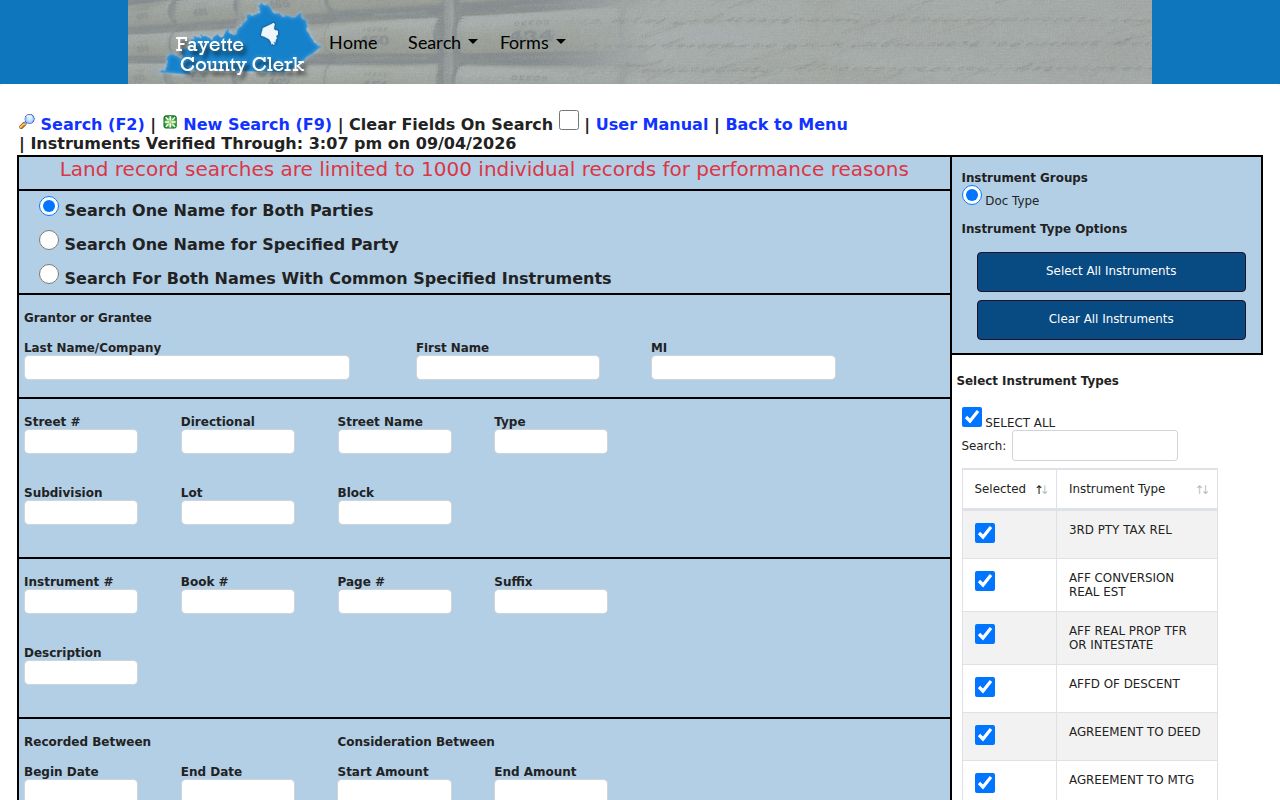
That screen rewards precision. A book and page or street clue narrows a name search and keeps results under the cap.
Read Fayette's Grantor-Grantee Chain
A grantor conveys the stated interest; a grantee receives it. Start from the CAMA card's DBook, DPage, and DDate when they appear. Open that instrument, copy its description and names, and work backward through each party who conveyed the tract.
- Find the likely current deed by book/page or search the present name as grantee.
- Open the image and transcribe both parties, the date, and exact legal description.
- Search that grantor as an earlier grantee, with a date and deed-type filter.
- Repeat while the description continues to match, then inspect plats and estate instruments at breaks.
- Grantor
- The party conveying the stated interest.
- Grantee
- The party receiving the stated interest.
- Chain of title
- The connected sequence of instruments affecting ownership.
- Book/page or instrument number
- References used to retrieve a recorded filing.
Fields on Fayette Deed Results
The public result layout shows recording date and time, instrument code, book code, book number, page number, last and first names, and an image column. Grantee names display in red. A name-only row proves nothing by itself. Open the instrument and confirm the role, the description, and any later filings. The result layout also carries a last-update marker. That marker reflects maintenance, not full historical coverage, so save the search time when a recent transfer matters.
Fayette Deeds After the 1866 Fire
An 1866 courthouse fire makes old Fayette County deed records a source-by-source project. The official fire reference does not name every volume lost or rebuilt. No specific missing book should be assumed. A blank online result may reflect a web cutoff or a spelling variant. It may also point to a gap in the physical index. A local history lead lists deed volumes spanning at least 1848 through 1903. The ranges overlap. The Alabama Department of Archives and History can identify microfilm and county holdings. Later confirmation deeds, probate orders, tax proof, and plats can bridge a break in the chain. Newspaper notices can bridge it as well.
Old-book caution. Confirm the earliest web year and a cited volume's custody before treating an online miss as a lost deed.
Plats and Liens in Fayette Records
Lot-and-block land should be matched to its recorded plat. Fayette's index accepts subdivision, lot, block, description, and PLAT filters. One local lead names Herren Subdivision, Lots 1 and 2, Block 3, North Fayette. Another places Wages Subdivision at Book 1, page 176, with a vacated street. These are leads, not a subdivision inventory. Mortgages, assignments, judgment liens, tax liens, mechanics liens, easements, releases, and lis pendens can all appear in Fayette County property records. They often sit beside the deed chain. Pair any lien with its later satisfaction. A lis pendens signals a court action whose final disposition deserves a check too.
Estate Transfers in Fayette Deeds
A deed-to-deed line can break when an owner dies. Search WILL, CERTIFIED WILL, AFFD OF DESCENT, intestate transfer, ORDER, DISCLAIMER, deed, and release types. The Fayette Probate portal routes users to probate case and land records. Detailed fields and the oldest online year are not exposed. Match the estate filing to the same description and parcel. A will explains authority or descent, while the recorded land instrument marks the property event. Ask the Probate Office for a case file or certified copy. Do this when the web path ends.
Get a Fayette County Deed Copy
Decide early whether an ordinary photocopy will do or a certified copy is required, and say so when ordering. Copy, certification, and subscription prices are not fully posted, so confirm current charges with the office before sending payment. The Judge of Probate sits at 113 Temple Ave N, Fayette, AL 35555, with counter hours Monday 8 a.m. to 5 p.m. and Tuesday through Friday 8 a.m. to 4 p.m. Reach staff at 205-932-4519 or 205-932-4566, stop by in person, or mail the request to P.O. Box 670. Give the names, instrument type, date range, and the book and page or instrument number. Include every spelling the index shows, the party role if known, and whether an image or certified copy is wanted. If a citation points to an old volume, ask whether the original, microfilm, or a later copy is what the office can produce. The Alabama Public Records Law lets residents inspect and copy public writings unless an exception applies, and custodians may set written procedures and reasonable fees. One precise request beats asking for everything under a name.
Once the copy arrives, count the pages and check the attachments before closing the file. Exhibits, legal descriptions, signatures, acknowledgments, and stamps often follow the first page, and a missing exhibit can hold the very language that ties the deed to the Fayette County parcel. Keep a search log with the index URL, the search date, the instrument type, the book and page, and whether the image was complete. If a correction deed or rerecording appears, pull both versions and compare the exact change. That discipline matters most when a CAMA card shortens an owner name, or when a will, affidavit, or court order supplies the transfer authority. Treat the stated consideration with care too. An amount field can narrow an index search, but family transfers, estate instruments, corrective deeds, reserved interests, and mixed real and personal property can all skew the figure. The recorded text and the surrounding chain give context no single index number can.
Match the land itself across instruments. For rural tracts, compare acreage, section-township-range calls, roads, streams, and adjoining owners from deed to deed; street addresses change while those older calls persist. For a city lot, track the subdivision, lot, block, plat reference, and any vacated street or easement. A parcel map helps orient the description, but the deed, plat, and survey remain the boundary sources. When an instrument points to litigation, search the Fayette Circuit Clerk for the case and its final disposition. A lis pendens flags pending litigation, while a judgment lien or order may need a later release or satisfaction. Fayette County sits in Alabama's 24th Judicial Circuit. Online court access runs through the paid Just One Look service, and the courthouse counter remains the route for certified, archived, or omitted material.
Finish with a full chain review. Compare every transfer date against the recording date, since signing and recording are separate events. Note any gap, correction, reserved life estate, power of attorney, or name change, and never merge two people just because their names match. Search for releases after mortgages and liens, and read both the referenced instrument and its release. If the legal description shifts, figure out whether the record shows a split, combination, exception, easement, or a different tract before continuing backward. Fraud deserves attention as well. The Alabama Property Protection Act takes effect October 1, 2026 and targets seller-impersonation fraud; the Alabama Securities Commission was still drafting its procedures and forms. Fayette County offers no local fraud-alert signup, so owners should watch recorded filings through official channels and report a suspected false land sale through current state and local processes rather than trusting an unverified alert service.
Recorded, not guaranteed. An indexed Fayette deed is evidence of filing, but it does not establish clear title, settle unrecorded claims, or replace a boundary survey.