
Start a Fayette County Property Search
The best Fayette County property search narrows from a broad clue to one exact parcel. Start with the free county CAMA system. It accepts a physical address, an owner, an account, or a structured parcel entry. What comes back supplies the bridge fields you will use everywhere else. Those include the account, full parcel string, owner name, deed book, deed page, and deed date. Save the result year as well. The tax roll and the deed index update on different schedules. Matching several keys beats trusting a single name.
- Enter the physical street number and street name in Fayette County Public GIS/CAMA. Start with fewer terms if a full address produces no match.
- Open the result and save its Account, full Parcel Number, Owner's Name, S/T/R, and parcel address.
- Carry the displayed DBook, DPage, DDate, or owner name to the Fayette Deeds land-record search.
- Compare the parcel against the tax-bill search and map. Note the year or verification time displayed by each system.
- Ask the Revenue Commissioner or Judge of Probate for a copy when an online image, older index, or recent update is missing.
Fayette CAMA Search Fields
The CAMA report labels itself Fayette County Alabama 2025 Public GIS. Four modes appear: Basic, Parcel, Land, and Bldg. Each mode exposes more filters than a plain address box. The built-in instructions say to enter one or more criteria without typing too much. For owners, the sample Jones W shows the style. A spyglass control then zooms the map to the parcel.
| Field | Input | Useful detail |
|---|---|---|
| Owner | Name plus condition selector | Try surname, initials, estate, trust, or company variants. |
| PhyAddr # / St Name | Separate text fields | These are the physical or situs address fields. |
| Account / Parcel(s) | Text and structured blocks | Use the whole returned parcel string. |
| Land and value | Acres and value ranges | Useful when a rural tract lacks a firm street address. |
| Deed / land location | Book, page, dates, S/T/R | These connect a card to a deed or older description. |
| District / Use / Exemption / Subdivision | Selectors | Good for narrowing a known class of parcels. |
Blue underlined controls open still more boxes. Parcel mode adds a MaxRecords control. The portal makes no stable bulk-download promise and lists no full historic coverage date, so treat the live fields as search tools rather than proof that every old tract or image is online.
Search Fayette Property by Address
Type the house number and street name into their separate portal fields. Rural addresses sometimes fail on a full match. Drop the road type or directional, then try variants like Highway and Hwy. A street-name-only query works when the house number changed. It also works when a tract lacks a standard situs number. It can return several cards along the same road. That is often enough to spot the right parcel in Fayette County.
Do not let a ZIP code decide the county. Postal routes cross county and municipal lines, and Glen Allen itself reaches into Marion County. Confirm the situs in CAMA and read the county listed on the record. An old deed with no modern street address calls for different anchors. Use acreage, the section-township-range, the legal description, adjacent owner names, and book/page references instead.
Note: Owner mailing address and parcel address may differ, so neither field alone proves where a person lives.
Owner Names in Fayette Records
An owner-name property search in Fayette County should try several forms. CAMA may abbreviate a life estate. A recorded instrument may name spouses, trustees, an estate, or a company in a different order. Search the surname alone, surname plus first initial, business name, trust wording, and close spellings. A common surname returns too much, so pair it with a road, a date, a parcel, or an instrument type.
Fayette Deeds offers grantor, grantee, and combined-party modes. The difference matters. A grantor conveys an interest; a grantee receives it. The deed portal caps a broad query at 1,000 individual records, so apply date and instrument filters to narrow a common name. CAMA's listed owner is only an assessment-roll clue. The latest recorded grantee is the stronger check on a current transfer.
Save Fayette's Full Parcel Key
The parcel number is the strongest exact link in a Fayette County property search. Keep every block intact. One sample looks like 32 05 08 33 0 000 010.000 0. The portal never labels what each block means. So avoid guessing at the code. Account numbers are separate internal keys. S/T/R sits in its own field.
- Parcel or APN
- The structured tax-map identifier returned by CAMA.
- Situs address
- The physical location of the land, which may differ from the owner's mailing address.
- Owner of record
- The name currently carried on the assessment roll, which can lag a deed.
- S/T/R
- Section, township, and range, a land-location cross-check for rural tracts.
Splits, combinations, and re-parceling can all change a parcel key. An old deed may point to a retired number. Preserve that number and follow the deed's legal description forward instead of forcing it into the current format.
What Fayette Property Results Show
A CAMA result packs a lot into one card. It reads like an assessment and tax snapshot for a single tract in Fayette County. The parcel details can point you toward a recorded deed. They never replace the deed itself. Two sample cards make that point clearly: one lists a separate situs and mailing address with life-estate wording, while the other repeats the same address in both spots. Context matters when you read every field.
| Identity | Account, Parcel Number, Owner's Name, Parcel Address, and Owner's Address |
|---|---|
| Land location | S/T/R, acres, neighborhood, tax district, and subdivision |
| Values | Land, improvement, total market value, exemption code, use code, and yearly tax |
| Deed bridge | DBook, DPage, and DDate for a recorder-index follow-up |
The card proves less than it seems. It does not establish current title, occupancy, a legal boundary, or a sale appraisal. A full legal description may be missing too. For those answers, pull the recorded instrument, the plat or survey, and a check for any later filings.
Carry Fayette Results to Deeds
Take DBook, DPage, and DDate straight from CAMA into the Fayette Deeds index as your lead. The land-record portal is flexible beyond that. It can search by street number, directional, name, street type, subdivision, lot, block, instrument, book, page, description, recorded dates, consideration range, group, and instrument type. Party fields accept grantor, grantee, or combined-name queries. The result shell lists the recording date and time, instrument code, book code, book and page numbers, party names, and an image column. Image and certified-copy charges stay hidden until a result opens. The earliest online index year is not printed either. Call the Judge of Probate at 205-932-4519 or 205-932-4566 when the image, an old index, or an exact copy fee is unclear. In-person research at the courthouse works too. Mail goes to P.O. Box 670, Fayette, AL 35555. For a deeper instrument walkthrough, the Fayette County deed records page follows grantor and grantee roles without turning this search route into a full chain-of-title lesson.
Fayette Deed Search Screen
The official Fayette land-record index shows how party, property, date, and instrument choices combine.
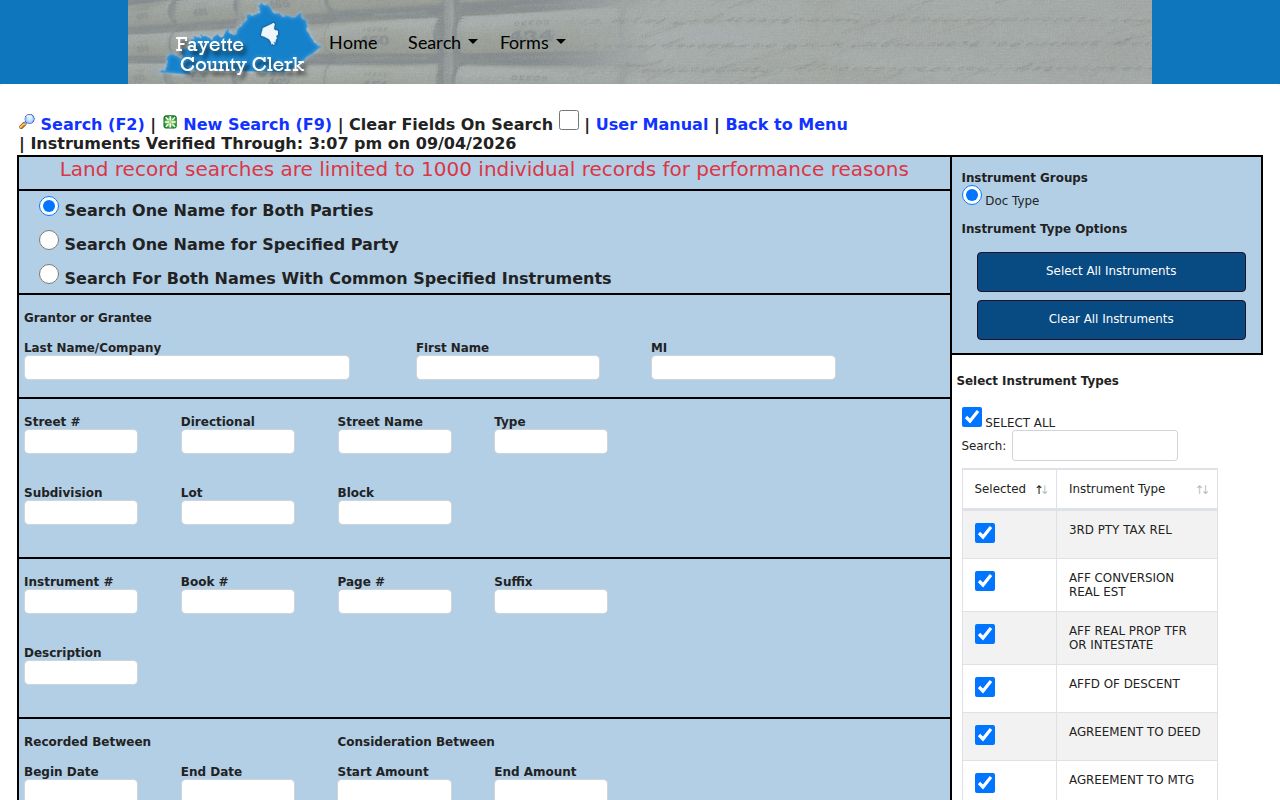
This deed search screen earns its keep after CAMA supplies a name or a book/page lead. Narrow inputs avoid the portal's 1,000-record ceiling.
Fayette Search Fallback Channels
Online failure is not the end. The Revenue Commissioner keeps the assessment and tax route at the Fayette County Courthouse, 113 Temple Avenue N, and answers at 205-932-6081. The Judge of Probate holds recorded land instruments there. Older land books live elsewhere. The Alabama Department of Archives and History county-record database supplies finding-aid and microfilm leads, though physical custody often remains local. Historic deed references can also be tested through archive or FamilySearch catalog channels. A missing web hit means little. It may reflect an image gap, an index spelling problem, an old volume, or a record held only at the counter. It does not prove the instrument never existed.
Compare Fayette Property Search Keys
Match the key to what is already known. When a result runs too broad or too thin, change routes and rely on two or more independent details.
| Search Key | Best For | Where It Works | Watch Out |
|---|---|---|---|
| Address | One known site or a street | CAMA/GIS | Road forms, missing situs numbers, and changed names |
| Owner name | Parcels or instruments tied to a party | CAMA and Fayette Deeds | Trusts, estates, life estates, initials, and same names |
| Parcel or account | An exact tax-card match | CAMA and tax bill | Splits, old parcel numbers, and format differences |
Not a title search. A Fayette County property search finds public clues and recorded documents, but it does not guarantee clear title or replace a survey or legal opinion.
Date each lookup. The CAMA screen carries a 2025 label, while the deed index displays a live instrument-verification time. A recent transfer can appear in one system first.
When no address result appears, go back to the original source of the address. A tax notice may use Address 1. The deed may rely on a road or metes-and-bounds description. CAMA separates the physical number from the street name. Preserve punctuation and directionals. Test a shorter form too. For acreage, add known acres or S/T/R only after the broad road query works. Too many filters can hide a valid result.
When the name result runs broad, search the same party in Fayette Deeds with a role and a date range. Add a deed, plat, mortgage, release, will, or affidavit type only when the property question supports it. The portal's common-instrument modes help. The underlying image still decides who signed, which interest moved, and which legal description was attached. Copy a company or trust name exactly from the record before testing variants.
A four-document verification packet works well for Fayette land: the dated CAMA card, the latest matching recorded deed, the relevant tax bill, and a plat or survey when boundaries matter. Note the key used in each system. If the parcel card contains life-estate wording, do not shorten it to a fee-simple ownership claim. Search the named life tenant in the deed and probate indexes. Search any remainder parties there too.
Requests under the Alabama Public Records Law should identify the record held by that custodian. Give the Revenue Commissioner an account, parcel, and year. Give the Probate Office a party, instrument type, date, and book/page. Ask for inspection, a copy, or mail delivery. A custodian may use a standard form, estimate a reasonable fee, and seek enough detail to locate the record.
Older research can extend beyond the courthouse web pages. Alabama archives maintains county-record finding aids and microfilm leads. The Fayette County Memorial Library runs a genealogy department and holds local organization minutes. These sources help explain an old name, road, or chain gap, but they do not replace the recorded deed or the current card. The library is at 326 Temple Ave N and lists 205-932-6625. Treat directory, newspaper, or census entries as context. Then reconnect it to the parcel through a legal description or book/page.