
Find Out Who Owns a Fayette County Property
Two Fayette County systems hold the answer. The tax roll lives with the Revenue Commissioner. Its Alabama GIS/CAMA card shows the tax roll's Owner's Name. The Judge of Probate keeps the Fayette Deeds index of recorded instruments. Use the assessor card for a likely property owner, then confirm the grantee and land description in the deed, keeping each system's date because the tax roll can trail a fresh conveyance.
- Enter the physical street number and street name in the Fayette Public GIS/CAMA search.
- Open the matching card and save its full parcel string, Owner's Name, DBook, DPage, and DDate.
- Use those deed references or party names in Fayette Deeds, then inspect the latest instrument and its legal description.
- If a trust, estate, life estate, or company appears, follow the deed or probate context instead of shortening the name to an individual.
This route never assumes a tax mailing address proves residence. For the fine print on a present roll entry, the current-owner guide covers the parcel fields in depth.
Where Fayette County Labels the Property Owner
The 2025 CAMA report calls the roll entry Owner's Name. That field sits among Account, Parcel Number, and Parcel Address. It also shows Owner's Address, acres, exemption, use, and value. The card carries the last deed book, page, and date fed into the assessment system. Those deed and parcel details cut down same-name mix-ups in a property search. Separate situs and mailing fields exist. They stop anyone from reading an address as proof of occupancy.
Owner of record: the name on the current assessment roll. Grantee: the party receiving an interest under a recorded deed. Situs: the parcel's physical address. It may differ from the owner's mailing address. Title: the legal ownership interest. No single database field can settle it.
Try short name forms first. The portal's own example uses a surname and initial. One Fayette County sample runs long. An owner string there gets cut off at a life-estate notation. Such text is a routing clue, not a legal conclusion. Note: Preserve the entire parcel string, because it separates similarly named owners and bridges the assessor card to the deed index.
A Fayette Life-Estate Label Changes the Route
One Fayette County card shows the compressed entry TURNER MICHAEL ALLEN LIFE ESTA. The text just stops. A copied name is not enough. A life estate splits two interests. Present possessory rights sit apart from a later remainder. The CAMA label leaves that split unexplained. A recorded deed, will, affidavit, probate order, or later release supplies the missing context. Follow the card's DBook, DPage, and DDate to the recorded image, then search related names and instrument types, including wills, affidavits of descent, intestate transfers, orders, and releases, all supported by the Fayette Deeds type list. Truncated roll text cannot settle who may sell, inherit, or occupy.
Which Fayette County Records Identify an Owner
Each Fayette County record answers a different slice of the owner question. The tax-roll name is the fastest find. A recorded deed is the stronger proof of conveyance. GIS maps add geographic context, while probate or court files may explain an estate, partition, quiet-title action, or another break in the chain.
| Where ownership appears | What the source contributes | How to reach it |
|---|---|---|
| Revenue Commissioner CAMA card | Owner's Name, mailing and situs addresses, parcel, and deed reference | Free public search, or Revenue Commissioner at 205-932-6081 |
| Judge of Probate land index | Grantor, grantee, recording date, instrument code, and book/page | Online Fayette Deeds; courthouse counter or request |
| Public GIS report | Roll name tied to parcel geography and S/T/R | Free report and map route |
| Probate or court file | Estate, partition, or quiet-title context when a deed trail is incomplete | Probate Office; Circuit Clerk; paid Just One Look details |
Sometimes the grantee is a company, not a person. The Alabama Secretary of State's business entity records can identify that entity, though the filing never replaces the deed. A registered agent is not automatically the beneficial owner or the parcel occupant.
Confirm the Fayette County Grantee in the Deed
Fayette Deeds offers three party modes. One searches a name across both parties. Another targets a single named party. A third pairs two names with common specified instruments. Start with the CAMA book and page. If that fails, run the owner string as grantee, narrow by recorded date, and compare street, subdivision, lot, block, description, or consideration fields. The result view exposes recording date and time, instrument code, book code, book number, page number, party names, and an image column. Open the instrument before trusting any result as the right conveyance. A matching surname is weak evidence alone. Initials, spouses, trusts, and estates vary between indexes. The official recorded-land search at Fayette Deeds is the confirmation point for the whole method.
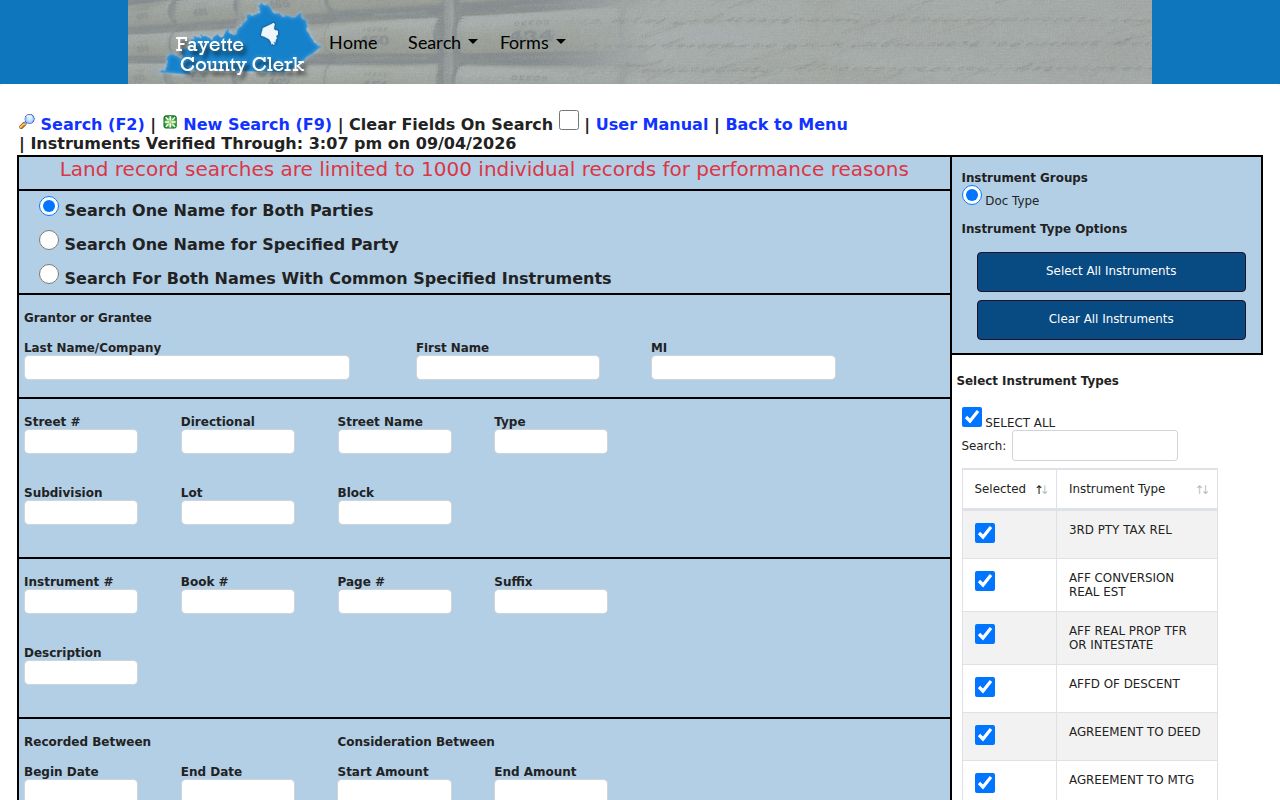
That view is crowded with fields. Party, date, property, and instrument options explain why parcel clues should ride along instead of a broad Fayette County surname.
When Fayette County Systems Disagree After a Sale
The CAMA report identifies itself as a 2025 tax system, while the deed index displayed an instruments-verified timestamp during the 2026 inspection. Those dates reflect distinct update cycles. Alabama Revenue also tells a buyer to record the deed and assess the property even if a tax bill remains in the previous owner's name. Fayette County publishes no exact closing-to-roll lag.
When names differ, date both searches, inspect the latest recorded conveyance, and call the proper office. The Revenue Commissioner can explain the assessment-roll entry at 205-932-6081. The Judge of Probate recording office, at 205-932-4519 or 205-932-4566, can address the recorded instrument and copies. Do not force two snapshots into agreement without that chronology.
The 1866 Fire and an Older Fayette Owner Search
Fayette County's courthouse burned in 1866. The Alabama Department of Archives and History documents the event. What the fire destroyed, deed by deed, is not itemized in the official record. The same goes book by book. So a missing online result proves nothing about whether an older ownership record ever existed. The trail can often be rebuilt. Confirmation deeds filed after the fire, probate orders, plats, tax evidence, and newspaper notices can each carry the story back another step. So can microfilm copies.
For an older Fayette County owner search, start with the ADAH county-record database. Search by county and record type. Then ask the Probate Office about surviving deed books. Also ask about the portal's Old Index Books control. Be honest about reconstruction. Say plainly when a link between records is inferred rather than backed by an original instrument.
Note: The live Fayette Deeds search page publishes no exact back-year cutoff. Treat any starting date as unconfirmed.
Limits on Who Owns a Fayette County Property
A tax roll entry names an owner of record. It does not settle occupancy, marketable title, or the authority to convey. A surveyed boundary can differ from what the card suggests. Mailing addresses exist for assessment correspondence, not for republishing without a sound property purpose. Trusts, estates, companies, and life estates can also hide the legal answer. The label often looks like a plain name.
Use owner data with care. A Fayette County owner lookup supports purchase research, boundary questions, estate work, and civic review. It must not be used to stalk, harass, intimidate, or harm anyone, and it is not a title search.
When real rights turn on the answer, go deeper. Pull the deed and the supporting records. Then take them to a qualified title professional or attorney. The public indexes are research tools. They are not a warranty of ownership.
Alabama law also shapes what an ordinary records request can produce. The Alabama Public Records Law, Ala. Code § 36-12-40, opens an inspection and copying route, subject to exemptions and custodian procedures. Sections 36-12-43 through 36-12-45 permit written procedures and focused requests. A Fayette County portal may not show the instrument you need. Build a precise request instead of a broad one. Name the parcel, the book and page, the parties, and the date span. Ask the office for that record. An open-ended request for files about a person is the wrong shape.
A CAMA card carries three addresses, and they are not one fact. The Parcel Address marks the land's situs. The Owner's Address is where mail goes. A deed's return address may tie only to the recording transaction. None of them shows who is physically present. The same caution covers an exemption code and a tax district. Both help you read the tax record. Neither proves residence or the power to convey.
Court files can explain an owner label, but use the narrow channel. Fayette Probate handles both probate cases and recorded land work. The Circuit Clerk keeps District and Circuit Court files. Alabama's Just One Look sells case detail and images. A judgment, partition, quiet-title action, or probate order is context only. It becomes evidence when matched to the correct parcel and recorded instrument. Keep the source, date, and legal description with every conclusion you draw.