
Trace Fayette County Former Owners Backward
A backward deed chain begins with a known instrument, never a guessed historic name. Each transfer is a row that must match the same land. The table models the evidence worth capturing, and it makes no claim about transfers it has not verified.
| Transfer date | Grantor to grantee | Instrument | Book/page |
|---|---|---|---|
| Newest date | Immediate prior owner to current grantee | Deed type as indexed | Current card's DBook/DPage |
| Next earlier date | Predecessor to that grantor | Warranty, quitclaim, estate, or other transfer | Earlier cited volume/page |
| Older-book date | Names read from the prior deed | Deed book or probate-linked transfer | Probate or microfilm reference |
That discipline keeps a pile of same-name search results from turning into a false history. At every step, compare the legal description and parcel clues before accepting the next link.
Start With Fayette DBook, DPage, and DDate
The Fayette CAMA card lists DBook, DPage, and DDate. They sit right beside the parcel and owner fields. Copy them exactly. These values bridge a modern tax parcel to the Judge of Probate's land index. You never have to begin with a broad former-owner surname. Treat them as your anchor. The portal accepts book, page, instrument, party, date, street, subdivision, lot, and block criteria. It also accepts description and consideration criteria. Read each deed's grantor, grantee, type, and legal description. Then use that grantor as the next prior grantee and keep stepping back. Note: A deed reference copied into the tax roll may lag behind the newest conveyance when the assessment system has not caught up.
Read Fayette's Prior-Transfer Result Layout
The public result shell at Fayette Deeds lists recording date and time, instrument code, book code, book number, page number, party names, and an image column. Grantee names display in red. That color cue helps you spot the receiving party at a glance while walking the chain.
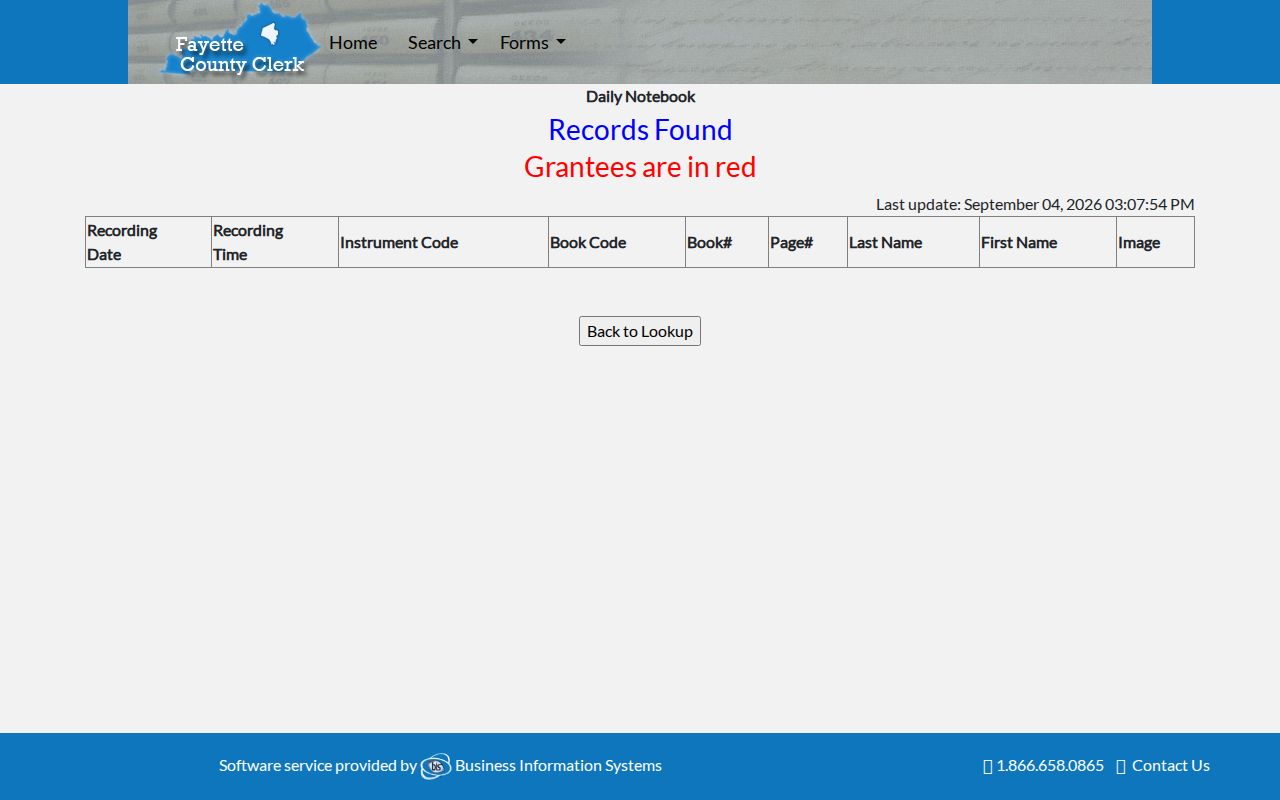
The screen supports a backward chain by book and page and by party role. It does not deliver a parcel-specific history on its own. Never infer a transfer from matching names alone.
Reconstruct Fayette County's Deed Chain in Reverse
Fayette Deeds can search one name across both parties, one name in a specified party role, or two names linked by common instruments. Use party roles deliberately. Each earlier owner should appear as a grantee before showing up as a grantor.
- Find the latest deed by current book/page and verify its land description.
- Record its grantor as the immediate previous owner for that interest.
- Search that grantor as an earlier grantee, narrowed by date and description.
- Repeat until the portal stops, then carry the citation to Probate or microfilm.
- Grantor / grantee
- The conveying and receiving parties named in an instrument.
- Reverse index
- A party index used to follow a name in the opposite role.
- Chain of title
- The connected sequence of instruments affecting the same land.
Follow Fayette Land Before Street Addresses
Older conveyances describe land by subdivision and lot, acreage, S/T/R, road, creek, railroad, or adjoining owner. Search those clues when a present street number returns nothing. Preserve the parcel string. Leave its numeric blocks uninterpreted unless the county supplies a legend. For a lot-and-block parcel, pull the plat. For rural land, compare S/T/R, acreage, grantors, and metes-and-bounds calls. Addresses and city limits change, while the legal description stays the stronger test of continuity.
Use Fayette Probate and Lien Side Trails
A tidy run of sale deeds is never guaranteed. A former owner may have died. Ownership may have passed through an estate. It may also have been a retained life estate, a court order, or an affidavit. When the next grantor fails to match the last grantee, search between the apparent deeds. Fayette Deeds indexes wills, affidavits of descent, intestate-estate transfers, orders, powers of attorney, releases, mortgages, liens, and plats. All sit among its instrument groups. Probate material can tie an estate name to heirs or to a later deed. A release can show that a mortgage or lien ended. The owner of record does not change. A Circuit Court partition, quiet-title matter, or foreclosure may explain unfamiliar parties. They can appear in a later conveyance. The Fayette Circuit Clerk keeps the local files. Just One Look offers paid statewide case access. Court results still must be joined to the recorded land instrument. Never insert them as an owner transfer by assumption.
Wages Subdivision Preserves a Fayette History Clue
A 2014 City of Fayette document identifies Wages Subdivision. It works through Lot 7, Lot 9, Book 1/page 176, 5th Avenue NE or Ayers Road, and a vacated street. Municipal records like this can point straight back to a Probate book and plat. Test the subdivision name, lot, book and page, road variants, and the vacated-street fact together. The city document adds context. The county deed and plat carry the evidence. This trail earns its keep when a current address refuses to match older recorded language.
Bridge Fayette's 1866 Courthouse-Fire Uncertainty
The Alabama archives fire reference records a Fayette County courthouse fire in 1866. It does not list every affected series. A missing result proves nothing about whether a transfer occurred. Work around the gap instead.
Test later deeds that recite an earlier conveyance. Try probate orders, tax evidence, plats, and newspapers. The ADAH county-record database helps too. Secondary deed-volume ranges from 1848 through 1903 still require verification with Probate or ADAH.
Carry Fayette Prior Owners Into Offline Records
For deed books and recording help, visit the Probate Office at 113 Temple Avenue N. Staff there answer copy questions and pull volumes that never reached the web. Call 205-932-4519 or 205-932-4566 first to confirm access, the volume you need, and the current fee. Posted courthouse hours run Monday 8 a.m. to 5 p.m. Tuesday through Friday hours run 8 a.m. to 4 p.m. A mail request works best when it names the last verified book and page, the parties, an approximate date, and the legal description. Avoid asking for every record tied to a surname.
Two remote repositories extend the Fayette County chain. ADAH's county-record database points researchers to microfilm by county and record type. FamilySearch's Alabama wills and deeds collection spans material described as the 1700s through 2017. Image access varies, though. Either one can bridge a gap, but only when the person, land description, dates, and citations all line up. Log the repository, film or volume number, and page so another researcher can reproduce the link.
Know Where Fayette County's Online Chain Stops
Fayette County's online deed index hides its earliest year. The live Fayette Deeds page offers Old Index Books and a 1,000-record cap. Yet neither guarantees full historic coverage. Search narrow, then carry the last solid citation to the Probate counter. ADAH and FamilySearch discovery tools can pick the chain up from there.
Coverage limit. Fayette County's exact online back-year is unpublished. Never invent a cutoff or treat an absent web result as proof that a prior owner never held the land.
Tracing prior owners serves house history, estate work, and due diligence. Never use it to track or harass a living person. For a single instrument, see the deed-records page.
The Fayette Deeds portal caps results at 1,000, which wrecks broad surname work. Narrow any earlier-owner search by recorded-date range, instrument group, subdivision, lot, block, street, or description. You can also use a consideration range, or a known book and page. Individual instrument types include corrected and condominium deeds, easements, restrictive covenants, land contracts, and releases. They also cover tax liens, judgment liens, lis pendens, wills, and estate-related transfers. A chain built only on the generic deed group can skip the very document. That document may explain a name change.
Historic tax rolls and directories support a transfer, but cannot replace one. The Library of Congress holds Fayette telephone directories from 1974-75 through August 1981. ADAH guidance points to federal census schedules through 1950 plus Alabama state censuses from 1850, 1855, and 1866. Such sources can place a name near an address in a given year. Streets, routes, town limits, and mailing conventions still shift over time. Match each clue to a deed description, plat, or probate record before naming a former owner.
A strong research log matters here. Record each former owner exactly as indexed. Note that party's role, instrument type, recording date, book and page, legal-description clues, and the source. Flag an inferred bridge separately from a direct deed link. A later deed may recite an older transfer that has dropped out of the available run. In that case, quote the citation without claiming the original survived. That discipline counts most around the 1866 fire. The official fire list confirms the event, not the fate of every Fayette County record series.
Spelling variants and initials deserve the same care. Write them down exactly as they appear. A small difference can split one person into two. It can also show how an estate, spouse, or company entered the chain.