
What Fayette Tax Records Contain
Fayette County property tax records live in two places. The CAMA assessment card identifies the parcel and breaks out the value components, while the tax-bill search tracks a given tax year and any delinquent status. Neither document works as a deed, a survey, or a sale appraisal.
| Field | What It Shows | Where |
|---|---|---|
| Parcel identity | Account, parcel, owner, and two address fields | CAMA card |
| Value components | Land, improvement, and total market values | CAMA card |
| Tax context | District, exemption, use, yearly tax, and report year | CAMA card |
| Bill lookup | Bill number, year, parcel, address, and delinquent filter | Tax bill search |
Assessed value is the taxable slice, calculated under state class rules. Total market value is simply the assessor's tax value. The figure printed on a bill is not a sale price, so treat it as something other than a private appraisal.
Fayette's 2025 Tax Snapshot
The CAMA report carries a 2025 label. One sample card shows 21 acres, $36,400 in land value, and $162,900 in improvements. That card lists a $199,300 total market value. It also shows $951.22 in 2025 tax. Another shows 2.6 acres, $9,400 land, and $5,100 improvements. That card lists a $14,500 total market value. It also shows $14.80 in yearly tax.
These examples explain the fields, not county averages or current sale prices. Their exemption codes differ. An Exmt flag is a lead worth taking to the Revenue Commissioner. It is not proof of residence or qualification.
Fayette Assessment Classes and Ratios
Alabama materials place Class I property at a 30 percent assessment ratio, Class II at 20 percent, and Class III at 10 percent. Qualifying Class IV property follows its own rules. The class, plus any exemption, shapes both assessed and taxable value. The Alabama Department of Revenue assessment page supplies the state framework. For how it applies to one Fayette parcel, confirm with the Revenue Commissioner.
That state source also helps you separate the CAMA total market value from the assessed value that actually drives the tax calculation.
Find a Fayette Property Tax Bill
The Fayette tax-bill search takes a Last Name, First Name, bill number, tax year, account or parcel number, and Address 1. A "Show Only Delinquent Bills" filter narrows the results. Searches cap at 1,000 records.
- Find the Account or full Parcel Number on the CAMA card.
- Enter it in the bill search and choose the needed year.
- Use name or address only when the exact key is unavailable.
- Save the search date and ask the Revenue Commissioner about payment or correction.
- Assessed value
- The value produced after the applicable assessment ratio.
- Mill rate
- A tax rate stated per thousand dollars of assessed value.
- Exemption
- Qualified relief reflected in the taxable calculation.
- Tax lien
- A public claim arising from unpaid property tax.
Fayette's October-to-May Tax Calendar
Alabama property taxes come due October 1 and turn delinquent after December 31. State guidance schedules probate steps for February or March. Notice publication follows in April, and tax sales come in May. One Fayette notice was dated April 7, 2026. It described a May 8, 2026 courthouse-front sale covering tax year 2025. Treat it as a past notice, not a standing calendar.
| October 1 | Tax becomes due. |
|---|---|
| After December 31 | Unpaid tax becomes delinquent. |
| April | Sale notices are advertised. |
| May | Tax sales are generally held. |
Verify the current notice, parcel, year, sale stage, and terms. Remember that a certificate or tax deed does not by itself establish clear title.
Why Fayette Bills Can Lag Deeds
A bill can stay in a former owner's name long after a sale closes. Under Alabama Revenue rules, the buyer must record the deed and assess the property, and tax responsibility applies even while the old name sits on the bill. Compare the latest recorded deed with the CAMA year and the bill year.
The Revenue Commissioner sits at 113 Temple Avenue N, Fayette, AL 35555, phone 205-932-6081. Online search, a phone call, an in-person counter check, and a clear written request are the documented channels for resolving a roll question.
Fayette Tax Sale and Redemption
State guidance separates a certificate assignment, used while state-held property is under three years old, from the later tax-deed stage. Redemption can happen within three years by paying tax, interest, fees, and penalties at 12 percent, depending on the governing route. Paying another person's tax never makes the payer the owner.
Sale-status warning. A delinquent Fayette bill is not proof of final ownership or clear title.
Protest a Fayette Assessment
Start with the assessment notice. Compare parcel identity, acreage, improvements, class, and exemptions against what you know. Alabama guidance allows a written protest to the county Board of Equalization within 30 days of the valuation notice. The notice date controls. Useful proof includes the correct deed, a survey, photographs, and repair facts. It also covers comparable sales and evidence of a wrong improvement or land figure. State appeal guidance is available from Alabama Revenue.
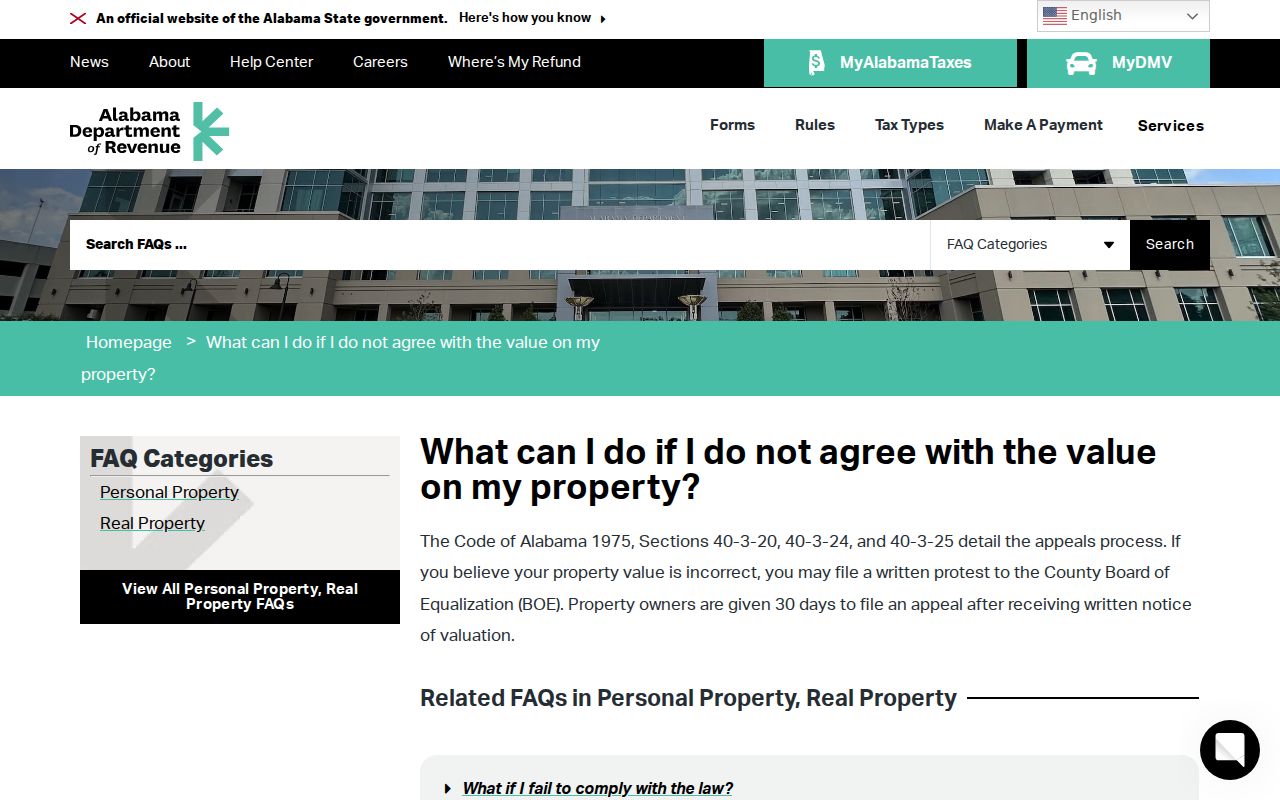
The state guidance sets the route, while the Fayette office supplies the parcel record and the local meeting details.
Appeal window. File the written protest within 30 days of the valuation notice and confirm receipt with the Fayette office.
Check the valuation notice before the bill arrives. The notice starts the appeal clock. Keep your copy of it, the protest, any exhibits, and proof of delivery. Ask which tax year is under review. Some errors can be fixed as a field correction before a formal board hearing. Staff cannot decide a legal claim for you. They can, however, identify the record, form, schedule, and current values the county carries. Remember what a protest is. It challenges the county's value or classification work. A deed dispute follows a different route. So does a boundary issue, a tax-sale title question, or an exemption eligibility fight. Separate each claim and back it with the record that controls it. For value, bring parcel facts and market evidence. For ownership, use recorded instruments. For a line on the ground, use a survey. That separation keeps Fayette County property tax records useful without asking them to prove facts outside the tax system.
The county card gives you an audit trail after a decision. Save the old and new land value, improvement value, total market value, class, exemption, and yearly tax. Compare the same parcel and year. A split or changed account can make two records look like one. If the bill ignores a resolved change, contact the Revenue Commissioner with the board outcome and both record dates. Exemptions need their own care. Bring the parcel account and ask which application, proof, and filing date apply. The Exmt field alone never explains why relief was granted, denied, changed, or removed. Do not infer age, status, or occupancy from a low tax figure. The county file and the state rule control. Delinquent accounts deserve the same precision. Request a payoff tied to the parcel and date. Online amounts shift as interest, costs, or payments post. Preserve the bill number, tax year, legal notice, and receipt. If a tax sale has begun, sort out its stages. The advertised sale, certificate stage, state-held status, redemption, and later deed are separate events. Each has its own date and legal effect.
Fayette County property tax records are public accounting tools. Privacy and lawful-use limits still apply. Share only the parcel and financial facts a purchase, appeal, estate, or boundary task truly needs. Skip mailing details and personal data that add nothing to the property question. A precise record log supports due diligence without building a profile of a person. Splits and combinations deserve special care. Compare old and new account numbers, full parcel strings, acreage, and deed references. A tax amount can drop because the tract changed. The county may not have lowered the same assessment at all. Ask the Revenue Commissioner which tax year first reflects the new parcel. Also ask whether a prior bill remains open under the former account. Improvements can hit the roll on a different schedule from city permits. The permit date shows municipal review. The assessment card shows county tax treatment. Keep both dates if a new structure, removal, or major change is disputed. A permit does not set value. A CAMA improvement value does not prove every city approval was issued. Court action adds another wrinkle. A quiet-title suit, partition, foreclosure, or boundary case may explain contested payment or ownership, but the tax-bill system does not report the final legal result. Match the case number and disposition to any later recorded order, deed, lien, or release. Keep the docket and the tax record separate.
Compare years only when the parcel identity stays constant. Record land value, improvement value, total market value, Exmt, Use, Tax District, and yearly tax for each year selected. One changed line points to the next question. It does not explain its own cause. The county may have corrected a field, added an improvement, changed classification, processed an exemption, or created a new account. Ask for the source record instead of inferring from the amount. Then save the county response with its matching tax year. That short step keeps later bill checks tied to the same Fayette parcel and decision.